
Where A.I. pays off most on the production floor
From a long list of ideas to one fully worked-out case with a calculated payback period.
- Services
- Consultancy
- Platform
- Workshop · Odoo

Project Overview
Who is Ayano?
Ayano is a Belgian family business from Hoogstraten that decorates glass and bottles — think printed beer bottles, special trappist bottles, and drinking glasses for major brands. The decorating happens in-house and at established partners in Germany, Austria and Romania.
Ayano has been running Odoo as its central ERP system for about a year. Plenty of processes on the shop floor still ran on paper alongside it: quality sheets, production sheets and pallet slips. CEO Erwin Meeuwesen wanted to know what A.I. could actually change there.
The challenge
Ayano barely used A.I. yet, beyond some occasional ChatGPT use. At the same time, there was a long list of ideas: quality checks with photos, reading out machine data, scans going wrong, better support for sales. So the question to Flowkify was mostly about making a choice:
"We see plenty of possibilities with A.I., but where do we start? And how do we know upfront whether it will actually pay off?"
Ayano didn't want scattered experiments — it wanted a well-founded first step.
Project Delivery
The approach
We work in three steps: first find the value, then prove the value, then build the value. For Ayano we did the first two. An A.I. Opportunity Mapping to surface and prioritize every opportunity. Then a Business Value workshop to work out the most promising one in full, all the way to the business case.
1 · A.I. Opportunity Mapping
A workshop on-site at Ayano, together with the CEO, the operations and scanning lead, and a production consultant. The session went like this:
- Inspiration through concrete A.I. cases from production and industry.
- A walk through the company and its departments: production, quality, office and IT.
- Gathering pain points and mapping current A.I. use per department.
- Generating opportunities per A.I. category.
- Plotting everything on value versus complexity and prioritizing together with a voting round.
The session produced three fully worked-out concepts and a set of quick wins:
| Concept | What it does |
|---|---|
| Scan Assistant (P1) | A photo-based scanning assistant linked to Odoo that catches missing and incorrect pallet scans. |
| Quali AI (P1) | Digital quality registration through photo and voice, with complaint follow-up and machine reporting. |
| Sales Assistant (P2) | Visit reports, order analysis and proactive client follow-up based on Odoo history. |
On top of that, a set of quick wins: an A.I. notetaker for internal meetings and client visits, email tagging, and personal A.I. coaching for the operations lead.
The advantage: the management team went from a loose list of ideas to a shared list of priorities, with an MVP scope and the conditions for each concept spelled out.
2 · Business Value workshop on the Scan Assistant
The Scan Assistant came out on top. The reason: every day, time was lost on pallets that weren't scanned, or scanned wrong. In a half-day workshop with the operations lead, the production consultant and the CEO, we worked that case out in full:
- Setting the goal and the metrics: less manual sorting-out, fewer missed scans, faster response to the client, and higher client satisfaction.
- Mapping the current process step by step, from unloading through production to packing.
- Naming the pain points: unknown pallets, unreadable barcodes, a confusing scanner app, and duplicate actions for the operator.
- Working out a future vision: one simple tablet app per production line, with a big scan button and a progress bar until everything is scanned.
- Building a clickable mockup the team could try out themselves.
- Fixing the scope in 22 user stories, sorted into must, should, could and won't have.
- Mapping out the technical architecture: a custom web app on Azure in Western Europe, connected to Odoo through the API and to SharePoint for the production sheets.
- Calculating the business case together, using Ayano's own numbers.
Two details made the difference in that design. When a barcode is unreadable, the operator just takes a photo. A.I. reads out the SSCC code and the pallet slip details from it — production date, batch number, pallet number. And unclear cases don't land on the operator's plate, but in a validation list where the person in charge approves or corrects them with one click. So a human stays in control, without stopping the line.
The advantage: no more rough idea, but a well-defined first version with a scope, a timeline, an architecture and a calculated payback period.
Results
Ayano now has a clear picture of where A.I. pays off most in the company, and why. The priorities were set together with the people who do the work every day.
The Scan Assistant business case is concrete and positive. Today, about 2.5 hours a day go into manually correcting scans — roughly 550 hours a year. Combined with less printing and faster complaint handling, the expected value comes out to over 20,000 euros a year. The payback period for the full solution stays under two years.
There are also benefits you can't put a euro figure on: full traceability per pallet, better data quality, and operators who no longer need three tries before a scan works.
Flowkify keeps supporting Ayano as its A.I. partner, with a focus on scalable solutions and maximum impact.
Want to know where A.I. pays off most in your production? Get in touch with Flowkify for a custom A.I. Opportunity Mapping.
Ready to build your case?
Tell us where it's clunky. We'll design the flow and build it, often live within a few weeks.
No-obligation call · reply within 24 hours
Other cases
More work that delivered results.
 How Dewulf Group is getting a grip on A.I. and Copilot with a governance projectA.I. governance and Power Platform governance for an international machine builder.View cases
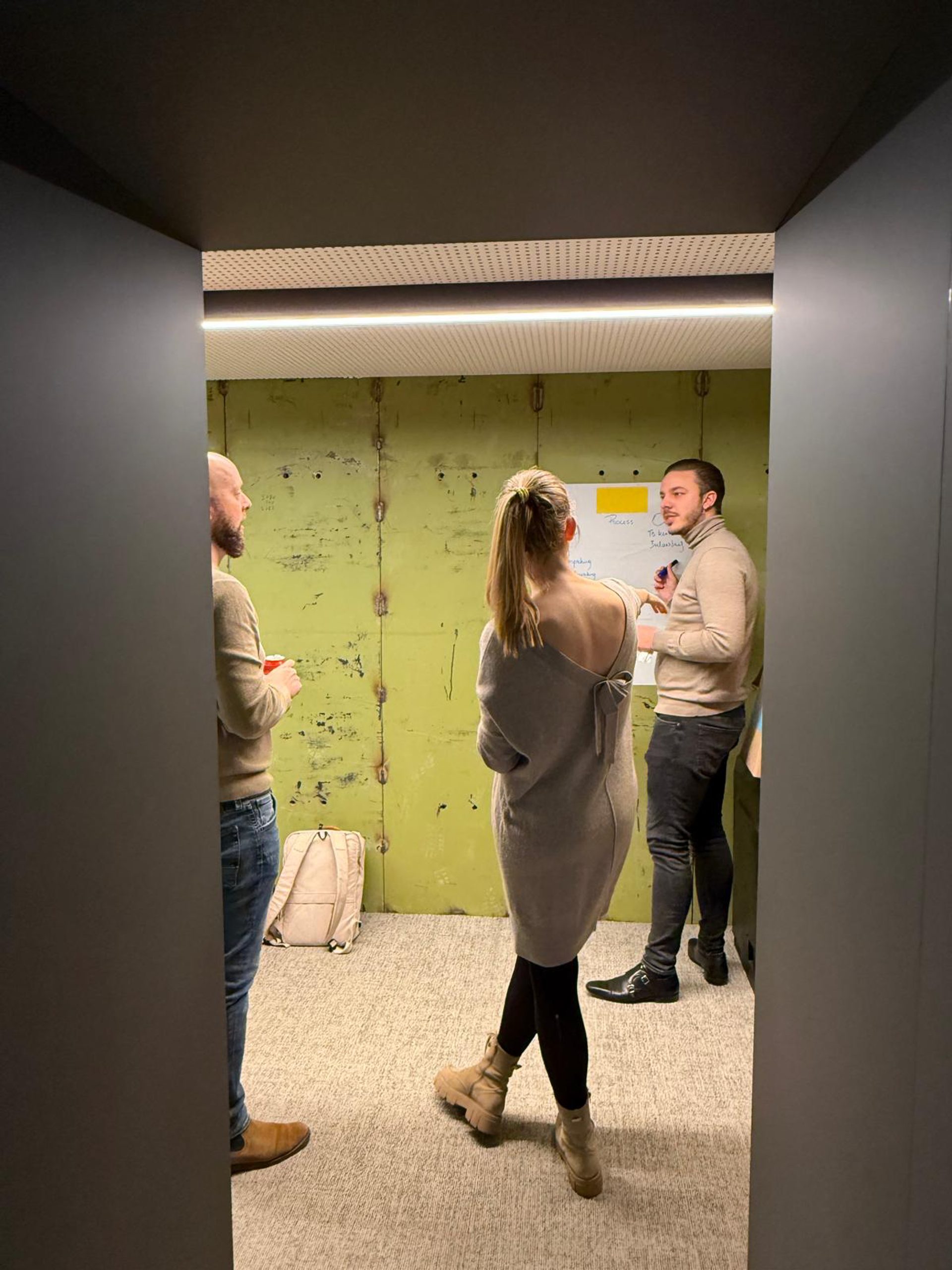 How Meraki went from A.I. trainings to a prioritized A.I. roadmapFrom A.I. training to a prioritized A.I. roadmap for an accounting and advisory firm.View cases
 How Expliciet automates meeting notes with an A.I. notetakerAutomatic meeting reports in SharePoint for a marketing agency with 40 employees.View cases


