
How Conversal made a well-founded choice on which A.I. copilot moves the agency forward
From a broad list of ideas to one fully worked-out copilot concept, with a business case and a buy-versus-build analysis.
- Services
- Consultancy

Project Overview
Who is Conversal?
Conversal is a digital agency from Affligem that guides companies on web design and online marketing. The agency works with two teams: one that builds websites, and one that sets up and runs campaigns for clients across different sectors. For the past few years, a creative studio has been part of the mix too. Management follows A.I. developments closely and saw a chance to make both their own work and their client services smarter.
The challenge
Conversal didn't want to treat A.I. as a one-off experiment, but as a permanent layer under its services. The idea: an in-house A.I. copilot that reads campaign data, summarizes results and gives advice — internally for the team first, and later possibly as a product for clients too.
"We want an A.I. assistant that supports our marketers and, over time, also adds value for our clients. But what do we build ourselves, what do we buy, and what does it actually deliver?"
Project Delivery
The approach
We work in three steps: first find the value, then prove the value, then build the value. For Conversal we did the first two steps. An A.I. Opportunity Mapping to surface and prioritize every opportunity, followed by a Business Value project to fully work out the most important one, all the way to the business case.
1. A.I. Opportunity Mapping
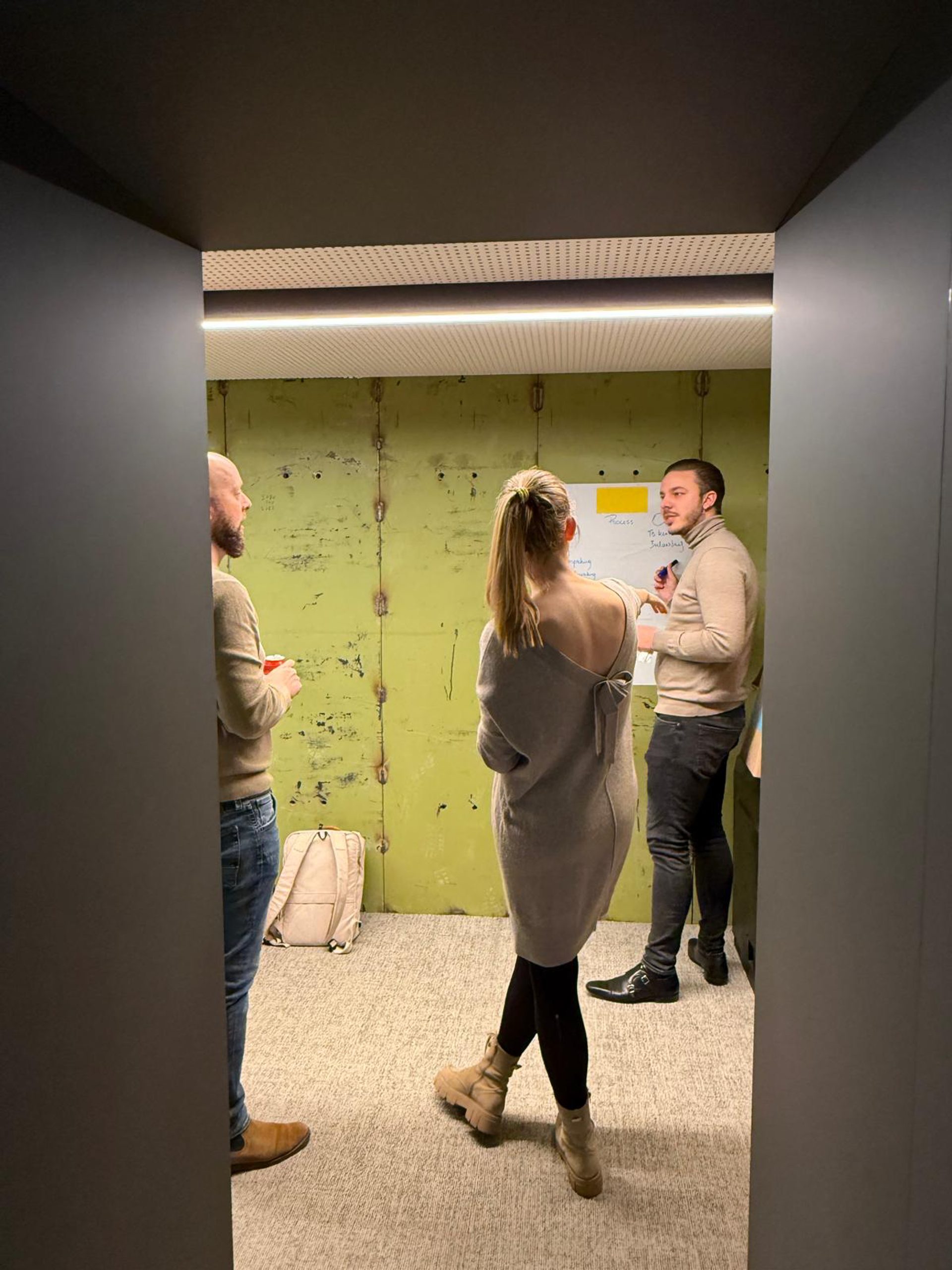
A workshop with management and the project leads from both teams. Here's how the session ran:
- Inspiration through concrete A.I. cases from marketing and services.
- Mapping out the process from prospect to client together, from intake through strategy to kick-off.
- Gathering the pain points and current A.I. use at each step.
- Generating opportunities per A.I. category.
- Plotting everything on value versus complexity and prioritizing together.
That produced one strategic initiative — the A.I. copilot — plus a quick win around automatic meeting reports.
The benefit: the team went from a broad list of ideas to a shared choice, with a clear read on value and complexity for each one.
2. Business Value project around the A.I. copilot
In a second phase, we worked out the copilot in full:
- Setting the goal and success metrics: less time spent on reporting, faster insights, stronger backing for client conversations.
- Building a clickable mockup of the chat interface, with example questions like "How did my campaigns perform last month?"
- Defining the scope in user stories for a first version.
- Mapping the architecture: a central data platform that pulls together campaign data from the various ad and analytics tools, with an A.I. agent and a chat window on top.
- Calculating the business case, using Conversal's own numbers.
We also ran a buy-versus-build analysis. We compared eleven existing reporting platforms on integrations, A.I. capabilities, flexibility and data security, and weighed those against building it in-house. That made it clear where an off-the-shelf tool is enough, and where building it yourself makes the difference.
The benefit: no more rough idea, but a defined first version with scope, architecture, a cost picture, and a well-founded choice between buying and building.
3. Quick win: A.I. notetaker
Alongside the bigger project, we put a fast win on the table too: an A.I. notetaker that automatically turns every meeting into a report with action points, in the agency's own house style and stored in its own cloud environment. The team stays in control — the report only goes out after approval.
The benefit: less time on write-ups and more context preserved after a conversation.
Results
Conversal now has a clear picture of where A.I. delivers the most inside the agency, and what it would cost to build. The copilot is worked out into a concrete MVP proposal: mockup, user stories, architecture, a cost estimate for building and running it, and a business case based on the agency's own numbers.
Just as important is what the project made clear about the alternative. The comparison with existing platforms showed where they hold up and where they fall short, especially around custom data models and data security. That turned the investment decision into a well-founded choice instead of a gut call.
The agency has since moved ahead on its own with several quick wins from the mapping. The worked-out file for the copilot is ready for the moment the build phase starts.
Curious where A.I. delivers the most in your agency? Get in touch with Flowkify for a tailored A.I. Opportunity Mapping.
Ready to build your case?
Tell us where it's clunky. We'll design the flow and build it, often live within a few weeks.
No-obligation call · reply within 24 hours
Other cases
More work that delivered results.
 How Dewulf Group is getting a grip on A.I. and Copilot with a governance projectA.I. governance and Power Platform governance for an international machine builder.View cases
 How Meraki went from A.I. trainings to a prioritized A.I. roadmapFrom A.I. training to a prioritized A.I. roadmap for an accounting and advisory firm.View cases
 How Expliciet automates meeting notes with an A.I. notetakerAutomatic meeting reports in SharePoint for a marketing agency with 40 employees.View cases


