
94 A.I. opportunities in a single workday
From pain points to a prioritized A.I. roadmap for CRM 3.0.
- Services
- Consultancy
- Platform
- Workshop

Project Overview
Who is ING Belgium?
ING Belgium is one of the country's largest banks, with offices across Belgium and its head office in Brussels. Inside the bank, a dedicated CRM team works on Iris, the bank's own CRM platform that's replacing Salesforce. Iris runs on the internal Digital Handling platform and supports the sales, service, and complaints workflows.
For years, the team was focused on rolling out and stabilizing the platform. That left little time to think about what comes next. The question was always there: what comes after Iris?
The challenge
The CRM team wanted a shared product vision for what they call CRM 3.0. Not just digitizing tasks, but adding real value for employees and customers. A.I. and automation stood out as the biggest levers to make that happen.
"How do we turn our CRM into a system that helps employees instead of feeling like an administrative burden, and where should A.I. come in first?"
Project Delivery
The approach: A.I. Opportunity Mapping
We started with an A.I. Opportunity Mapping — a guided workshop where a team maps its pain points, comes up with A.I. opportunities, and prioritizes them by value and complexity, all in a single day.
Before the workshop, we held two prep sessions with the CRM team, mapping out the organizational structure, the systems, and how Iris works. That let us tailor the exercise to the bank's own terminology and reality.
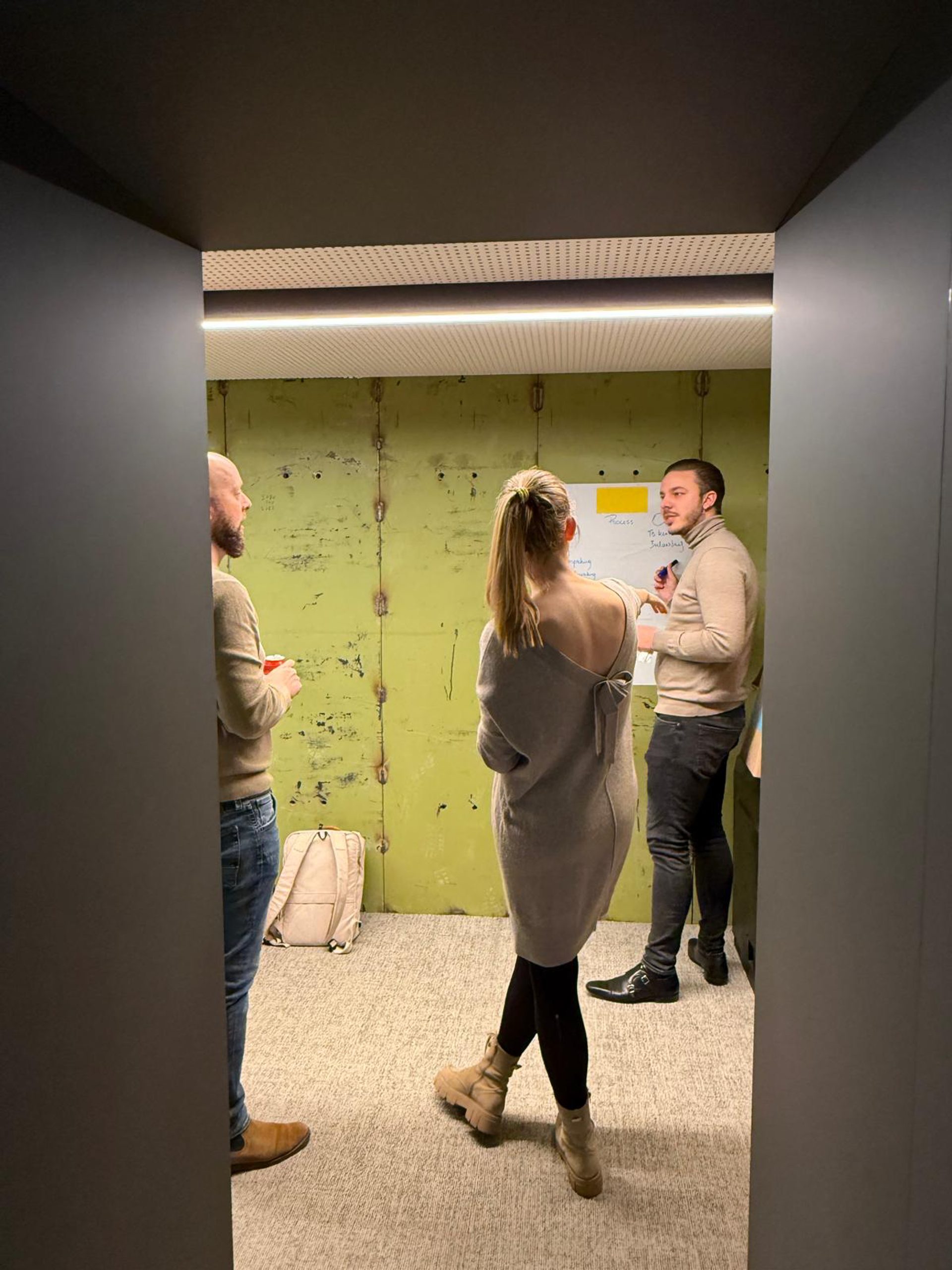
The workshop itself took place on Wednesday, October 16, 2025, from 9:30 am to 3:30 pm, at ING's head office in Brussels. Eight ING employees took part, from different disciplines and segments. The session ran in English.
We worked across four streams: Sales, Service, Complaints, and Datawise, the team behind the Digital Handling platform.
The day followed a set structure:
- Inspiration. We showed concrete A.I. applications that already work today, so everyone started from the same picture.
- Pain points per stream. Each team mapped out its own frustrations and bottlenecks in short rounds.
- A.I. opportunities. We used fifteen non-technical A.I. capabilities as a thinking framework — things like "helps with writing," "understands and analyzes text," and "connects software together." That way, everyone could contribute, even without technical knowledge.
- Building concepts. The teams combined individual opportunities into fully worked-out A.I. concepts, each with a name, a goal, and a way of working.
- Prioritizing. Every concept was placed on a matrix of business value versus complexity, with a voting round to determine the top picks.
What it delivered
1 · 94 A.I. opportunities across four streams
The team mapped 94 concrete A.I. opportunities in total. About 55 percent relate to the CRM 3.0 vision toward the customer. The other 45 percent are about the teams' internal productivity.
The benefit: ING now has a complete overview instead of scattered ideas per team.
2 · Nine A.I. concepts, prioritized into a roadmap
Those opportunities grew into nine fully worked-out concepts, split across three levels of potential. The three with the highest potential:
| Concept | What it does |
|---|---|
| Your Personal Secretary (Sales) | An assistant that supports the entire client meeting. Before the call, it puts together a briefing from CRM data, emails, and history. During the call, it surfaces insights and signals. Afterward, it produces a summary, action points, and a structured update in the CRM. |
| EmpathAI (Complaints) | An assistant that spots dissatisfaction early in a conversation, identifies the real issue behind the complaint, and suggests solutions before the complaint becomes formal. |
| ChatING (Datawise) | A chatbot that immediately turns requests for the Digital Handling platform into a structured file, checks documents, and suggests the next step. |
3 · A 28-page management report
Everything came together in a report covering the pain points per stream, all 94 opportunities, the nine concepts, and a recommendation for the next step.
The benefit: the team can share the results internally and use the report as a reference document.
4 · A concrete recommendation for the first step
Our recommendation: start with a pilot of Your Personal Secretary in the Sales stream, connected to Outlook and the CRM. That concept scored high on value and average on complexity, and can then extend to Service and Complaints.
Results
In one workday, the CRM team went from scattered frustrations to 94 mapped A.I. opportunities, nine fully worked-out concepts, and a prioritized roadmap. There's now also a shared vision for CRM 3.0, built around three pillars: high-quality, accessible data; A.I. agents that take over repetitive work; and intelligent automation.
Two weeks later, we discussed the report with the team. The insights made their way to the broader CRM organization and landed on the agenda of the quarterly review. The team is now working out the vision per stream, identifying quick wins, and preparing a pilot.
There are no hard numbers on time savings yet. Those will come out of the Business Value workshop, where we map the as-is process, the to-be process, and the ROI per user group.
Want to find out where A.I. would pay off most in your organization? Get in touch with Flowkify for a tailored A.I. Opportunity Mapping.
Ready to build your case?
Tell us where it's clunky. We'll design the flow and build it, often live within a few weeks.
No-obligation call · reply within 24 hours
Other cases
More work that delivered results.
 How Dewulf Group is getting a grip on A.I. and Copilot with a governance projectA.I. governance and Power Platform governance for an international machine builder.View cases
 How Meraki went from A.I. trainings to a prioritized A.I. roadmapFrom A.I. training to a prioritized A.I. roadmap for an accounting and advisory firm.View cases
 How Expliciet automates meeting notes with an A.I. notetakerAutomatic meeting reports in SharePoint for a marketing agency with 40 employees.View cases


