
Go or no-go for an A.I. chatbot
From idea to a well-founded go or no-go: goal, scope, architecture and business case for an A.I. chatbot.
- Services
- Consultancy
- Platform
- Workshop

Project Overview
Who is Vandelanotte?
Vandelanotte is one of Belgium's larger accountancy and advisory firms, with multiple offices and a broad range of services: from bookkeeping and tax to audit and advisory. The firm has been investing in its own digital solutions for several years now. One of them is a collaboration platform where the accountant and the entrepreneur work together in the same file.
That platform grew fast. And with the growth came the questions. Clients email, call, or search the portal themselves. Employees answer questions in between other work, without logging that time. That's a cost that shows up nowhere, but is very real. It's time that doesn't go toward advisory work.
The challenge
Vandelanotte was considering an A.I. chatbot inside the platform, so clients and employees could quickly find answers themselves. But they didn't want to start building on a hunch.
"How do we know in advance whether an A.I. chatbot would actually work for us, what exactly it should do, and whether the investment pays off?"
Many A.I. projects start with enthusiasm and end without a number. We call that phase Business Value, and that's exactly what was needed here.
Project Delivery
The approach
We always work in three steps.
- Find value (A.I. Opportunity Mapping). We find and prioritize the opportunities in your organization.
- Prove value (Business Value). We take one opportunity and work it out fully: goal, process, scope, architecture and business case. You end up with a well-founded go or no-go.
- Capture value (Solution Delivery). We build the solution and deliver measurable impact.
At Vandelanotte, the opportunity was already locked in. So we started straight away with step two.
1 · Intake and preparation
We began with an online intake. There, we brought the right people together and talked through expectations. Every participant got homework: think about today's pain points, about what you want to measure, and about where the priority lies.
That homework isn't a formality. It makes sure the workshop itself isn't lost to warming up.
2 · The workshop on site
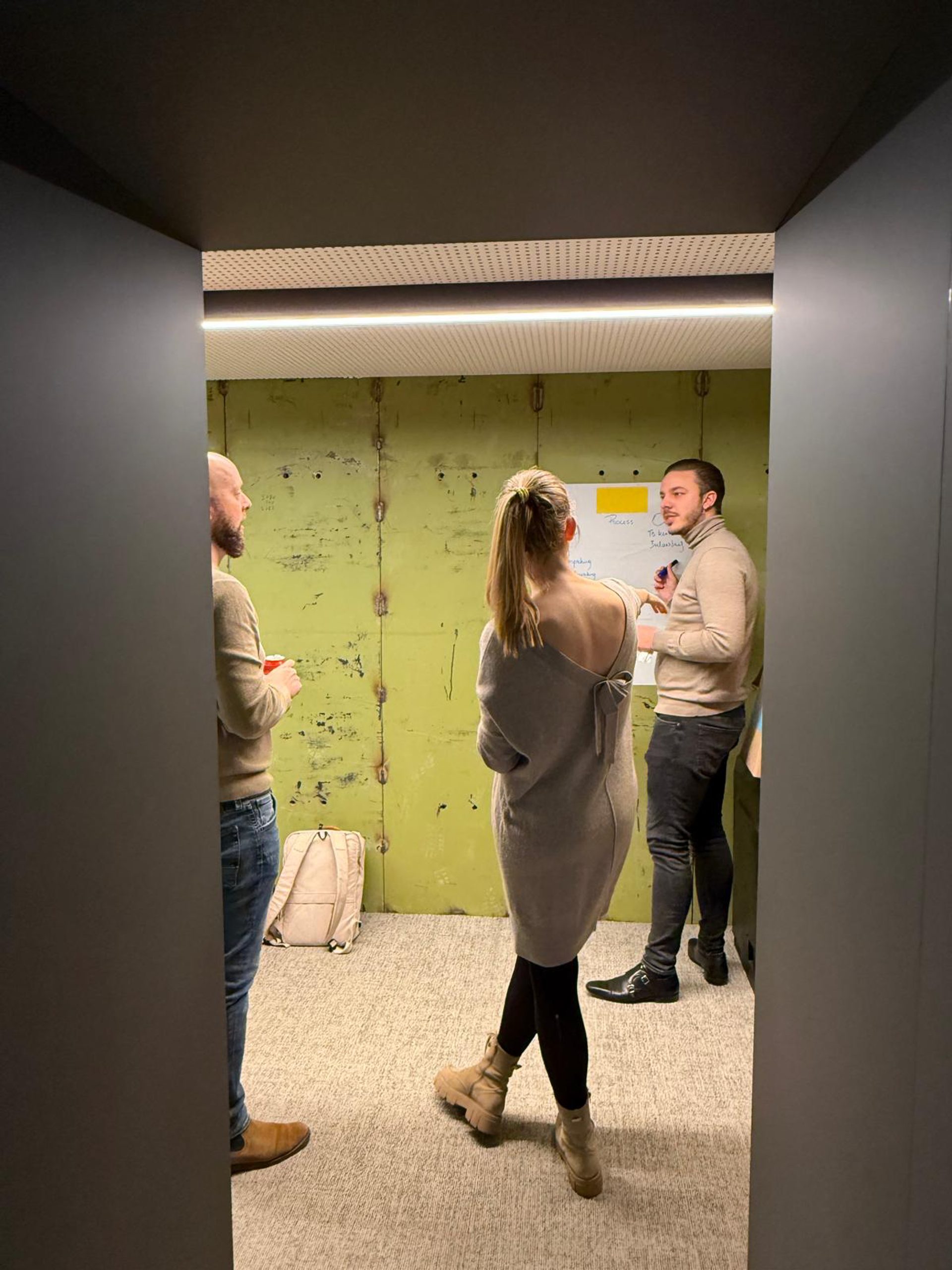
Next came a half-day on site, facilitated by our CTO. Around the table sat people from management, product, development and customer support together. That's deliberate: whoever hears the customer, whoever builds it, and whoever decides on it, need to watch the same picture take shape.
No presentation — a whiteboard session where we sketched and decided together.
3 · The deliverables
Within a few weeks of the workshop, a complete file was on the table, with six parts.
Goal and measurable KPIs. First, one clear goal in plain language: what do we want to achieve, for whom, and why is this a problem today. Below that, a short set of numbers that should move after launch: the number of support requests, platform usage, chatbot usage and customer satisfaction. Each with a clear direction: up, down, or a specific threshold. That way you know afterward whether it's working, not just whether it's there.
Process analysis: as-is and to-be. We mapped out how clients ask a question today and where it goes wrong. Slow, fragmented, and not always the same answer. One pain point stood out: some clients don't ask their question at all, out of fear of an extra invoice. Then we drew up the desired process, with the chatbot right where the question arises.
User stories with prioritization. We wrote user stories for every target group: the client, the employee and whoever manages the knowledge. Each story got a complexity estimate and a MoSCoW label: must have, should have, could have or won't have. That last one matters just as much as the first. It made explicit, in black and white, what would not be in the first version — which avoids a lot of discussion later.
Technical architecture. We worked out two scenarios, with an honest comparison on setup, scalability, cost, search quality and access management. One scenario is faster to launch, the other scales better. Both build further on the cloud environment the firm already uses, so the data stays within Europe. We didn't choose for them — we laid the trade-off on the table with the arguments behind it.
Roadmap in phases. No big bang. We proposed a build-up in phases, where each phase delivers value on its own and prepares the next. Starting with the simple questions, then the more complex ones, and only at the end the proactive assistant.
Business case and ROI. Finally, we calculated the added value. Not based on benchmarks, but on their own numbers from their own systems. Against that, we set an investment budget, the annual running costs and a payback period.
Our conclusion was that the business case is positive, but modest. We said so plainly. We'd rather sell an honest number than a pretty one. On top of that, a large part of the value doesn't show up in euros: less client churn, happier employees, and more time for advisory work.
Results
Before the workshop, there were mostly questions. A few weeks later, there was a decision file: a goal with KPIs, prioritized user stories, two worked-out architecture scenarios, a phased roadmap and a business case with a payback period. Enough to make an investment decision, and enough to start building the first phase right away. Participants called the session "eye opening."
Nobody had predicted the most important insight beforehand: everything stands or falls with a well-maintained knowledge base. Without structured documentation, no chatbot has anything to answer from. That investment is needed, with or without A.I. That insight shaped the order of the whole program.
"The big challenge, whether it's with a chatbot or simply a knowledge base on its own, is going to be maintaining it. Because the A.I. isn't going to know what to answer if it isn't in there."
That's the value of a Business Value program. You know upfront what you're building, what it costs, what it delivers, and in which order. And sometimes you also learn you need to do something else first.
Flowkify continues to support Vandelanotte as an A.I. partner, with ongoing conversations about a broader data and A.I. approach for the group.
Considering an A.I. project but want to know first if it's worth the investment? Get in touch with Flowkify for a Business Value program.
Ready to build your case?
Tell us where it's clunky. We'll design the flow and build it, often live within a few weeks.
No-obligation call · reply within 24 hours
Other cases
More work that delivered results.
 How Dewulf Group is getting a grip on A.I. and Copilot with a governance projectA.I. governance and Power Platform governance for an international machine builder.View cases
 How Meraki went from A.I. trainings to a prioritized A.I. roadmapFrom A.I. training to a prioritized A.I. roadmap for an accounting and advisory firm.View cases
 How Expliciet automates meeting notes with an A.I. notetakerAutomatic meeting reports in SharePoint for a marketing agency with 40 employees.View cases


