
Scheduling appointments without the round of phone calls
From dozens of A.I. ideas to one well-founded project: automatically scheduling appointments for the front desk.
- Services
- Consultancy
- Platform
- Workshop

Project Overview
Who is Verschaeren & Mertens?
Verschaeren & Mertens is an accountancy and advisory firm in Mechelen. The firm has been around since 1975 and today works with five partners and a sizeable team. They support startups, self-employed professionals, SMEs, holdings and liberal professions on bookkeeping, tax, corporate finance, HR and payroll, legal advice and estate planning. The firm is part of PIA Group, a group of accountancy firms across the Benelux.
The firm was already digitally strong. Accounting software, file management and time tracking were all neatly built into daily operations. A few employees had also already tried out A.I. tools. But it stayed at scattered experiments. The question was which A.I. application would really make a difference for the whole firm — not just for the people who enjoy playing with tools.
The challenge
"Where can A.I. pay off most for us, and how do we know for sure it's worth the investment?"
There was another layer to it. As part of PIA Group, the firm is bound by agreements around privacy and data security. Every solution therefore had to deliver value and clear that bar. Two representatives of PIA Group followed the process closely because of it.
Project Delivery
The approach
We always work in three steps.
- Find value (A.I. Opportunity Mapping). We find and prioritize the opportunities in your organization.
- Prove value (Business Value). We take one opportunity and fully work it out into a well-founded go or no-go.
- Capture value (Solution Delivery). We build the solution and deliver measurable impact.
At Verschaeren & Mertens, we ran steps one and two.
1 · A.I. Opportunity Mapping
We started with an intake with the managing partner and the person responsible for the front desk. There, we mapped out the software landscape, who needed to be involved, and which PIA Group rules applied. All participants received a questionnaire in advance about their pain points and repetitive tasks.
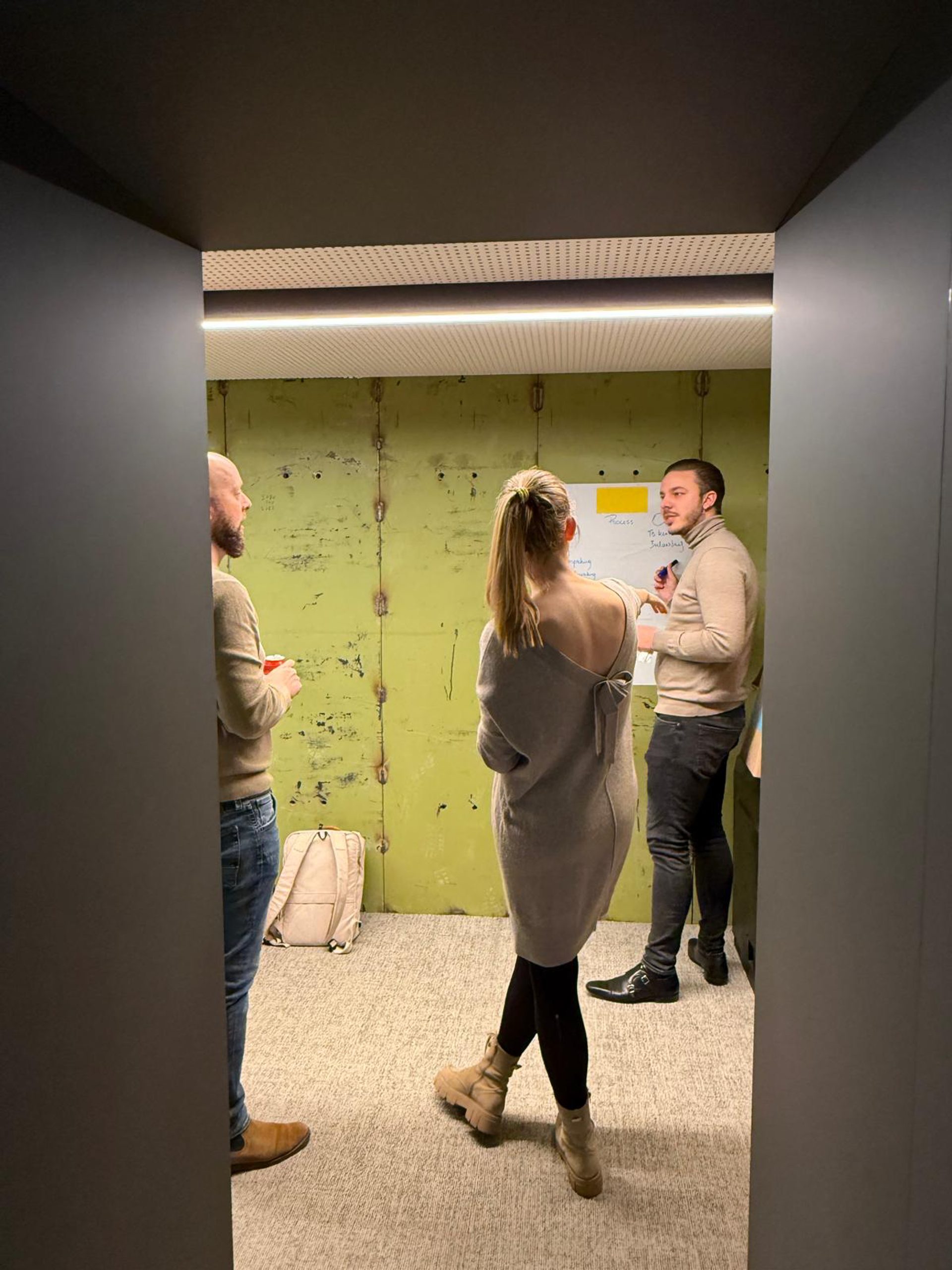
Then came a half-day workshop at the office, with around ten participants from every department: reception, accountancy, payroll, HR, IT and management. That's deliberate — the people doing the work know where it gets stuck.
The session ran like this:
- We walked through fifteen categories of A.I. applications with concrete examples, so everyone shared the same vocabulary.
- Per department, we gathered pain points and opportunities on post-its.
- In three small teams, participants worked out full concepts themselves, each with a name, a goal, and an estimate of value and complexity.
- We plotted everything on a value-versus-complexity matrix: quick wins, strategic initiatives, backlog and drop.
A few weeks later, we delivered the report: a management summary, the full backlog per department, and three top opportunities, each with an MVP proposal.
| Concept | Where it fits |
|---|---|
| PlanPulse | Front desk. Automatically scheduling and following up on appointments, starting from file management. |
| Project Scherp | Operations. A.I.-driven quality control on files, with pre-briefs for client meetings and coaching for juniors. |
| Task Flow | Management. Transparent task tracking and a fair distribution of workload. |
Alongside that, a list of quick wins the firm could pick up itself, from an A.I. notetaker to smarter email management and wide adoption of A.I. assistants across the team.
2 · Business Value workshop around PlanPulse
The firm chose PlanPulse as its first project. High value, limited complexity. We led an on-site workshop with the people who handle the process every day: front desk, file managers and team leads.
What came out of it:
The goal in one sentence. All client appointments scheduled automatically, at the right moment, without manual intervention.
The pain point, spelled out clearly. Scheduling client appointments takes a lot of the front desk's time: calling clients, matching availability, syncing calendars. It also has to happen at the right moment — not too early, not too late. Judging that right moment sat entirely in employees' heads. In practice, it took an average of four phone calls and three emails to lock in a single appointment.
Measurable KPIs. Time saved on calling and scheduling, less frustration for employees, a better client experience and fewer no-shows.
The process, drawn twice. First the current process, with every bottleneck marked: doesn't happen on time, client doesn't respond, file manager not ready yet, too many parameters, no-shows. Then the desired process.
Clickable mockups. We showed two screens: one from the client's side and one from the front desk's side. Everyone could try them out on the spot. Talking about an interface is very different from clicking through one.
User stories with MoSCoW prioritization. Written out per user role and sorted into must have, should have, could have and won't have. That last category matters just as much. It made explicit, in black and white, what wouldn't be in the first version.
A scope in three phases.
- Phase 1, availability management. Making partners' and employees' calendars available in real time, with a portal where the client picks their own time slot and an automatic invite goes out to everyone involved.
- Phase 2, automatic appointment scheduling. An integration with file management, a daily overview for the front desk, a follow-up flow to the client, and a voice agent that calls, proposes a time slot, and books the appointment on the spot — with a human in the loop, so an employee can take over at any moment.
- Phase 3, wrap-up and linked files. Scheduling linked files together, and automatically sending the client a summary report after the meeting.
Phases 1 and 2 together form the MVP.
Technical architecture. A custom web application on the cloud environment the firm already uses, with a separate environment per client. That keeps the data inside the existing managed framework, which was a hard requirement for PIA Group. We also defined exactly which action in file management triggers which action in PlanPulse, and vice versa. One technical limitation came up during the analysis, and we worked out the way around it right there, instead of discovering it later as a surprise.
A business case with a number. We calculated the annual added value against an investment budget and the annual running costs. Our conclusion: the business case is positive, but modest, with a payback period of under three years. We said so plainly. We'd rather sell an honest number than a pretty one. A large part of the value, by the way, doesn't show up in euros: calmer employees and clients who feel better looked after.
Results
The firm started with a broad question and a pile of scattered ideas. A few months later, there was a prioritized A.I. roadmap for the whole firm, a backlog per department, and for the first project, a complete decision file: goal and KPIs, the as-is and to-be process, clickable mockups, prioritized user stories, a three-phase scope, a technical architecture and a business case with payback period.
That's enough to make an investment decision. And it's enough to start building right away. All of it happened within PIA Group's privacy and data security framework, because the group was at the table from day one.
The biggest win wasn't the technology. It was the choice. From dozens of ideas to one project everyone understands: what it does, what it costs, what it delivers, and in what order it gets built.
Flowkify continues to support Verschaeren & Mertens as an A.I. partner, with PlanPulse as the first step and a backlog ready for what comes next.
Want to know where A.I. could pay off most at your firm? Get in touch with Flowkify for an A.I. Opportunity Mapping.
Ready to build your case?
Tell us where it's clunky. We'll design the flow and build it, often live within a few weeks.
No-obligation call · reply within 24 hours
Other cases
More work that delivered results.
 How Dewulf Group is getting a grip on A.I. and Copilot with a governance projectA.I. governance and Power Platform governance for an international machine builder.View cases
 How Meraki went from A.I. trainings to a prioritized A.I. roadmapFrom A.I. training to a prioritized A.I. roadmap for an accounting and advisory firm.View cases
 How Expliciet automates meeting notes with an A.I. notetakerAutomatic meeting reports in SharePoint for a marketing agency with 40 employees.View cases


